Choosing an excimer laser for pulsed laser deposition (PLD)
Short answer: The standard laser for pulsed laser deposition (PLD) is a krypton fluoride (KrF) excimer laser at 248 nm, delivering roughly 400–600 mJ per pulse in 12–20 ns pulses with pulse-to-pulse energy stability near 1%. Short ultraviolet (UV) pulses are absorbed in a thin surface layer of almost any target, so the film keeps the target's composition. LightMachinery Inc. (Ottawa, Canada) builds the IPEX-500, IPEX-700 and IPEX-800 excimer laser series for PLD, from single-user research labs to 24/7 large-area deposition. All three series hold their stabilized pulse energy at every repetition rate, use exciPure™ gas technology for long gas life, and run at 193, 248, 308 or 351 nm.
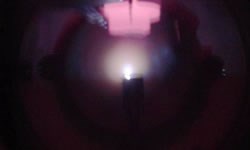
What is pulsed laser deposition?
Pulsed laser deposition is a thin-film growth method. A focused, pulsed laser beam enters a vacuum chamber through a UV-transparent window and strikes a rotating target of the material to be deposited. Each pulse removes a very thin surface layer, which forms a bright, expanding plasma plume. The plume travels a few centimetres to a heated substrate, where the material condenses and the film grows. A background gas, often oxygen at roughly 0.001 to 1 mbar, controls the plume and the film chemistry.
The key benefit is stoichiometric transfer: the film has the same ratio of elements as the target. Because each pulse delivers its energy in nanoseconds, every element in the target leaves together, instead of each one evaporating at its own rate.
An analogy: heating a material slowly is like boiling soup and collecting the steam. The most volatile ingredients leave first, and what you collect does not match the pot. A nanosecond UV laser pulse is more like taking a spoonful: everything in that layer leaves together.
Why do researchers choose PLD?
- Complex materials: multi-element oxides, such as the superconductor YBa2Cu3O7−δ (YBCO) and the manganite La1−xSrxMnO3 (LSMO), transfer with their composition intact.
- Atomic-layer control: growth happens in discrete bursts, so with in-situ reflection high-energy electron diffraction (RHEED) a single unit-cell layer can be counted and the run stopped exactly.
- Fast material changes: a new compound needs only a new target, often a small pressed pellet.
- Heterostructures and superlattices: a multi-target carousel switches materials between pulses.
- Wide process window: PLD tolerates reactive background-gas pressures far higher than molecular beam epitaxy (MBE) or electron-beam sources do.
- A clean energy source: the laser sits outside the chamber, so no filaments or hot crucibles contaminate the film.
PLD came to prominence in 1987 with the growth of high-temperature superconductor films, and it remains a leading method for complex oxides: ferroelectrics, multiferroics, magnetoresistive manganites, transparent conducting oxides and oxide interfaces such as LaAlO3/SrTiO3. It is also used for solid-state battery materials, piezoelectric films, nitrides, carbides, diamond-like carbon and hydroxyapatite biocoatings. Industrial PLD now includes large-area wafer coating and superconducting tape production.
How does PLD compare with other thin-film methods?
| Method | Complex multi-element films | Reactive gas pressure | Material changeover | Typical limitation |
|---|---|---|---|---|
| Pulsed laser deposition (PLD) | Excellent; composition follows the target | High (up to about 1 mbar) | Minutes; swap a target | Particulates; uniformity over large areas needs beam or substrate scanning |
| Magnetron sputtering | Good, but composition can need tuning | Low to moderate | Slower; target and conditioning | Composition shifts for some complex oxides |
| Molecular beam epitaxy (MBE) | Excellent, using one source per element | Very low (ultra-high vacuum) | Slow; source changes need venting or bake-out | Oxygen-rich growth is difficult |
| Electron-beam or thermal evaporation | Limited; elements evaporate at different rates | Low | Moderate | Off-stoichiometry for multi-element materials |
The best method depends on the material, the substrate size and the throughput needed. PLD is strongest where composition control and quick changes between materials matter most.
Have a target material in mind? Request complimentary sample processing in the LightMachinery applications laboratory.
Why are excimer lasers the standard light source for PLD?
An excimer laser is a gas laser that produces short, high-energy UV pulses from a mixture of a noble gas and a halogen. It combines the three properties PLD depends on: UV wavelength, high pulse energy and nanosecond pulse duration.
- Strong UV absorption: most oxides, nitrides and ceramics absorb strongly below about 300 nm, so the energy is deposited in a skin only tens of nanometres deep. Ablation is efficient and subsurface melting is limited. That melting is the main source of the micron-sized droplets ("particulates") that spoil films.
- High pulse energy over a large spot: typical PLD fluences are 1–5 J/cm². An excimer delivers hundreds of millijoules directly, leaving headroom for losses in the beam-delivery optics and the chamber window.
- Nanosecond pulses: pulses of a few tens of nanoseconds are short compared with heat diffusion in most targets, which is what makes congruent, stoichiometric ablation possible.
- A beam that homogenizes well: the excimer's large, rectangular, multimode beam has low spatial coherence. It can be imaged through a mask or homogenizer into a uniform flat-top spot with sharp edges and no speckle.
An analogy: a flat-top spot works like a cookie cutter, applying the same fluence everywhere inside a sharp edge. A Gaussian beam is more like a spray nozzle: too strong in the centre and too weak at the edges, which can raise particulate density and vary the ablation rate across the spot.
Excimer laser or frequency-multiplied Nd:YAG for PLD?
Some PLD systems use a diode-pumped or flashlamp-pumped solid-state laser, such as neodymium-doped yttrium aluminum garnet (Nd:YAG), frequency-tripled to 355 nm or quadrupled to 266 nm. Which source is better depends on the material, spot size and deposition rate required.
| Property | KrF excimer (248 nm) | Frequency-multiplied Nd:YAG (266/355 nm) |
|---|---|---|
| How UV is produced | Directly from the gain medium | Harmonic conversion of 1064 nm light, with conversion losses |
| Pulse energy in the UV | Hundreds of mJ per pulse | Typically lower at 266 nm; higher at 355 nm on large systems |
| Beam shape | Large rectangular beam, well suited to flat-top imaging | Smaller, near-Gaussian or multimode beam; homogenizing it takes more effort |
| Absorption in wide-bandgap targets | Strong for most oxides | Good at 266 nm; weaker for some materials at 355 nm |
| Running costs | Laser gas and optics maintenance | Flashlamps or diodes and nonlinear crystals |
| Typical fit | Most oxide PLD, larger spots, higher deposition rates | Smaller spots, compact or lower-energy systems |
Which excimer wavelength is best for PLD?
| Gas | Wavelength | IPEX stabilized pulse energy (x40 / x60 models) | Use in PLD |
|---|---|---|---|
| Krypton fluoride (KrF) | 248 nm | 400 / 600 mJ | The default choice: highest output, strong absorption in nearly all oxide targets, standard optics |
| Argon fluoride (ArF) | 193 nm | 150 / 200 mJ | Wide-bandgap or transparent targets that absorb poorly at 248 nm; needs more demanding optics and a nitrogen-purged beam path |
| Xenon chloride (XeCl) | 308 nm | 250 / 500 mJ | Long gas life and robust optics; used for some metals and polymers |
| Xenon fluoride (XeF) | 351 nm | 225 / 300 mJ | Used less often for PLD |
What should you look for in a PLD laser?
In PLD the laser is a process variable. Any drift in fluence, spot size or pointing changes the plume, the growth rate and the particulate density. Reproducible films depend more on stability than on peak output.
| Requirement | Why it matters | What to ask a laser supplier |
|---|---|---|
| Pulse-to-pulse energy stability | Fluence sets the ablation rate, plume energy and composition near threshold | Closed-loop energy control, about 1% (1σ) at the wavelength you will use |
| Energy independent of repetition rate | Runs move from single-shot calibration to 10–20 Hz growth | Stabilized energy specified at every repetition rate, not only at low rates |
| Stable beam profile | The imaged spot only stays flat-top if the raw beam keeps its shape | Profile behaviour over the life of the laser tube |
| Pointing stability | The spot sits metres away on a rotating target | Pointing in microradians, and whether realignment is needed after optics service |
| Pulse energy headroom | Optics, window coating and homogenizer losses reduce the energy delivered | Stabilized energy at your wavelength, with margin for your spot size |
| Gas lifetime | Refills interrupt long growths and halogen depletion reduces output | Gas usage while running (dynamic) and while idle (static) |
| Maintenance | Cleaning optics should not cost a gas fill or a realignment | Sealed optics ports and keyed mounts |
| Total cost of ownership (TCO) | Gas, consumables, spare parts, maintenance and downtime dominate lifetime cost | Gas use per million pulses, service intervals and uptime |
How much pulse energy is enough? Here is a worked example. A 3 mm × 2 mm spot (0.06 cm²) at 2.5 J/cm² needs 150 mJ at the target. If beam delivery and the chamber window lose about 40% of the energy, the laser must supply about 250 mJ. A 400 mJ KrF laser covers this with margin. A 600 mJ laser lets you double the spot area for higher, more uniform deposition rates.
Comparing PLD laser sources? Contact LightMachinery for a side-by-side specification review for your chamber and target materials.
Which LightMachinery IPEX excimer laser is right for PLD?
The IPEX line was originally developed by Lumonics and is designed and built by LightMachinery in Ottawa, Canada. All three series run on ArF, KrF, XeCl or XeF and share the same core optical specifications. They differ in duty cycle, maximum repetition rate and power. The figures below are at 248 nm (KrF) and come from LightMachinery's published specifications.
| Series | Best suited to | Models | Stabilized pulse energy (KrF) | Maximum pulse energy (KrF) | Maximum repetition rate (KrF) | Stabilized average power (KrF) |
|---|---|---|---|---|---|---|
| IPEX-500 | Research labs with intermittent use | IPEX-542 / 544 / 546 | 400 mJ | 475 mJ | 25 / 50 / 100 Hz | 10 / 20 / 40 W |
| IPEX-562 / 564 / 566 | 600 mJ | 700 mJ | 15 / 30 / 50 Hz | 9 / 18 / 30 W | ||
| IPEX-700 | Compact, medium-duty-cycle R&D and pilot production | IPEX-742 / 744 / 746 | 400 mJ | 475 mJ | 25 / 50 / 100 Hz | 10 / 20 / 40 W |
| IPEX-762 / 764 / 766 | 600 mJ | 700 mJ | 15 / 30 / 50 Hz | 9 / 18 / 30 W | ||
| IPEX-800 | High duty cycle and 24/7 operation, including large-area PLD | IPEX-842 / 844 / 846 / 848 | 400 mJ | 450 mJ | 25 / 50 / 100 / 200 Hz | 10 / 20 / 40 / 80 W |
| IPEX-862 / 864 / 866 / 868 | 600 mJ | 700 mJ | 15 / 30 / 50 / 100 Hz | 9 / 18 / 30 / 60 W |
Common to all IPEX series: 12–20 ns pulse duration (full width at half maximum, FWHM); 1% (1σ) energy stability at KrF; beam dimensions of 12 × 26 mm (x40 models) or 12 × 28 mm (x60 models); beam divergence of 1 × 3 mrad, reducible to about 0.25 mrad with optional high-brightness unstable-resonator optics; single-phase 200–240 V power; premix or separate gas cylinders; and optional air cooling for operation up to 25 Hz. Specifications are subject to change; see each product page for the current datasheet.
How does the IPEX design match what PLD needs?
- The same energy at every repetition rate: IPEX lasers hold their specified stabilized energy at every repetition rate from single shot to maximum. A fluence calibrated at 1 Hz still holds at 20 Hz, so you can change the rate without re-tuning the process. Some excimer lasers reach their rated energy only at low repetition rates.
- Closed-loop energy regulation: an energy monitor adjusts the discharge voltage and gas mixture to keep output constant in internal, burst and external-trigger modes. External triggering suits RHEED-synchronized, layer-by-layer growth.
- A beam profile designed for imaging: steep edges and a flat top, designed to change as little as possible over the life of the laser tube, so the homogenized spot stays the same from month to month.
- 200 µrad pointing stability, with no realignment after optics service: keyed, high-stability optics mounts keep the spot where it was on the target.
- Long gas life with exciPure™: LightMachinery's exciPure™ gas technology combines improved materials, a dual-stage filter that removes particulate and gaseous contaminants, and an improved stabilization algorithm. LightMachinery reports a 10× improvement in gas usage compared with competing lasers. Fewer refills mean fewer interrupted growths and steadier output between fills.
- Optics service without losing the gas fill: EasyClean automated valves seal the optics ports, so the resonator optics can be removed and cleaned while the chamber keeps its gas fill and passivation.
- Complete beam delivery: LightMachinery's in-house optical design team and integration partners supply laser and beam-delivery systems tailored to specific PLD set-ups.
Where are LightMachinery excimer lasers used for PLD?
LightMachinery excimer lasers, including the earlier PulseMaster series, are installed in PLD research laboratories around the world, among them the Institut national de la recherche scientifique (INRS) in Quebec, Canada, and the CNR Institute for Microelectronics and Microsystems (CNR-IMM) in Bologna, Italy.
Planning a new PLD system or upgrading an older laser? Request a quotation for an IPEX excimer laser.
What does an excimer laser cost to run for PLD?
Over the life of a PLD laser, the purchase price is only part of the cost. Total cost of ownership is driven by:
- Laser gas: for most excimer users, gas consumption is the largest running cost. Dynamic gas life (gas used while running) and static gas life (gas lost while idle) both matter. Static life matters most for research labs that run the laser a few days a week.
- Consumables and spare parts: resonator optics, windows, gas filters and, eventually, laser tube refurbishment.
- Maintenance time: how long optics cleaning takes, and whether it costs a gas fill, a re-passivation or a realignment.
- Uptime: lost growth runs and delayed experiments often cost more than the gas itself.
The IPEX design addresses each of these through exciPure™ gas technology, EasyClean optics valves, keyed optics mounts and single-sided service access. LightMachinery also provides parts, service and support for IPEX lasers and for earlier Lumonics excimer lasers.
How do you choose a PLD laser configuration?
- Most oxide PLD research: a KrF IPEX-544 or IPEX-744 (400 mJ stabilized, up to 50 Hz) is a sound default.
- Larger spots or higher deposition rates: choose an x60 model (600 mJ stabilized), such as the IPEX-564 or IPEX-764.
- Wide-bandgap or poorly absorbing targets: consider ArF (193 nm), allowing for its lower pulse energy and nitrogen-purged optics.
- Long shifts, 24/7 operation or large-area coating: choose the IPEX-800 series, up to 200 Hz and 80 W at KrF.
- Intermittent use on a tight research budget: the IPEX-500 series offers the same core optical specifications.
Whatever the laser, measure the fluence after the chamber window. Ablated material gradually coats the window and reduces the energy that reaches the target. A laser with stable output makes that drift easy to see and correct.
Frequently asked questions about lasers for pulsed laser deposition
What laser is used for pulsed laser deposition?
Most PLD systems use a KrF excimer laser at 248 nm, delivering several hundred millijoules per pulse in pulses of about 10–30 ns. ArF (193 nm) excimers and frequency-multiplied Nd:YAG lasers (266 or 355 nm) are also used for some materials.
What wavelength is best for PLD?
248 nm (KrF) is the most widely used because it combines high pulse energy with strong absorption in nearly all oxide targets. 193 nm (ArF) suits wide-bandgap or transparent targets that absorb poorly at 248 nm.
What fluence is used in PLD?
Typical fluences are 1–5 J/cm² at the target, set by the target material, spot size and growth conditions. Fluence should be measured after the chamber window, because window coating reduces the delivered energy over time.
How much pulse energy does a PLD laser need?
Enough to reach the target fluence on your spot size after optical losses. For example, 2.5 J/cm² on a 6 mm² spot needs about 150 mJ at the target, or roughly 250 mJ from the laser after typical losses. A 400–600 mJ KrF laser such as the IPEX-740 or IPEX-760 provides headroom for larger spots.
Who makes excimer lasers for PLD?
LightMachinery Inc. of Ottawa, Canada, designs and manufactures the IPEX-500, IPEX-700 and IPEX-800 excimer laser series for pulsed laser deposition, with stabilized energy at every repetition rate and exciPure™ gas technology for long gas life.
Talk to LightMachinery about your PLD laser
Whether you are building a new PLD system, replacing an older excimer laser or scaling up to large-area deposition, LightMachinery's laser team can help you choose the right wavelength, energy and repetition rate, and can process samples of your target materials in its applications laboratory.
- Phone: +1-613-749-4895
- Email: lasers@lightmachinery.com
- Web: www.lightmachinery.com | Contact form
- Address: LightMachinery Inc., 80 Colonnade Road North, Unit 1, Ottawa, Ontario K2E 7L2, Canada
Related: LightMachinery excimer lasers | IPEX-500 | IPEX-700 | IPEX-800 | IPEX-840/860 PLD Series datasheet (2014)
PULSED LASER DEPOSITION
LightMachinery excimer lasers are installed at key PLD research laboratories around the world


Learn More!

Excimer Lasers
Learn more about the powerful, ultraviolet, excimer laser

IPEX-800
Learn all about the versatile and reliable IPEX-800 Excimer laser